Envisioning the World From Medieval England
In the modern imagination, the medieval world is smaller and flatter than our own. But not only did medieval people know the world was round, they had seen and heard from more of it than we have often been lead to believe. These influences became part of how they understood themselves, their place in the world and in history, in various and sometimes unpredictable ways. Written narratives were, however, all the more important in both understanding and being understood by the rest of the world. How did different medieval English writers conceive of the world beyond their own shores? Reading a number of texts from the eighth century through the fourteenth, we will consider different writers’ different approaches to this question, the various sources they drew upon, adapted, and translated, and the ways they positioned themselves within the larger world.

Old English Love Stories
Old English literature is known for accounts of battles and saints’ lives and its famous elegies, and less so for its love stories. More than one scholar has debated the relative “prudery” of Old English literature. This class will read, in the original language, several of the various stories of love, sexuality, and romance that do exist, from elegy to romance to allegory and everything in between, to think about what love literature might have meant to the earliest English readers and writers.
In this class, we will study our primary texts in the original Old English, making use of tools including the Dictionary of Old English Web Corpus to tease out the subtleties of its language. And we will explore essays by scholars of Old English literature, entering into conversation about how this very old body of literature might best be understood in generations to come.
Riddles, Ruins, and Wretches: An Anthology of the Earliest English Poetry
Much of the oldest English poetry survives in a single copy, in an unusual manuscript known as the Exeter Book. We know little about this book’s history except that it was donated to Exeter Cathedral by a bishop in 1072 AD. The poems copied into this anthology range from lonely elegies uttered by wandering speakers to riddles, to dirty jokes set next to saints’ lives. The rest is mystery—some of the poems have identifiable sources, others don’t, and scholars have sought for centuries to explain why these poems were collected together, and why this book might have mattered to the bishop who left it to us. As we enter into this mystery, we will explore how the early English wrote their poetry, how medieval books were put together, and we might encounter a ghost or two. We will read the poems of the Exeter Book in translation(s), as well as relevant historical sources, scholarship, and theory. Come see “where all the ladders start”—a thousand years ago, when English literary history was only beginning.
Medieval America
Medieval America explores the relationship between medievalism and modern identity, juxtaposing scholars’ and political thinkers’ investments in medieval origins with medieval texts themselves. Our conversation begins with early modern European scholars’ motivations in studying and framing the medieval past, runs through US founders’ investments in claiming the “Anglo-Saxon” heritage of their country, and considers how the discipline of medieval English in the American academy has historically reproduced these reductive ideologies. How have modern race, religious identity, national identity, and ethnicity been conceived of in conversation with ideas of the Middle Ages?
To answer this question, we will juxtapose modern sources and the medieval texts that have given rise to and may ultimately challenge insular and simplistic narratives of medieval culture. What have been the modern stakes of retelling the medieval past? And how might recovering a more complete account of medieval sources help us to understand the world we live in now?
Beowulf
… he wære wyruldcyninga
manna mildust ond monðwærust,
leodum liðost ond lofgeornost
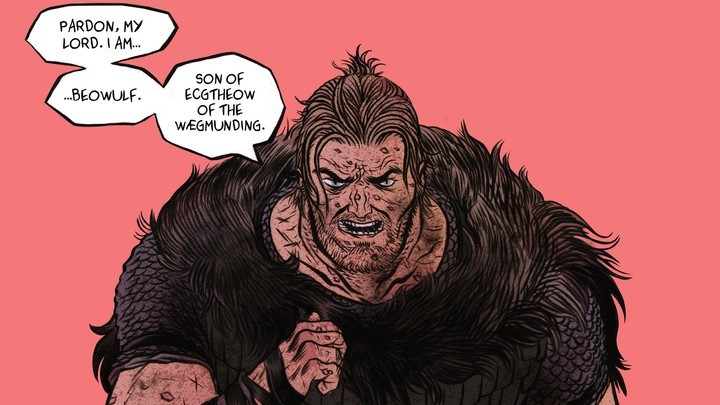
Since at least the nineteenth century, Beowulf has dominated both scholarly discussion and popular imagination of what Old English poetry is. But Beowulf is as mysterious as its march-stomping marauders: not one line of Beowulf is set in England, none of its heroes are English, and its action is set in a time before the first people who would become English had left continental Europe. It is the only Old English poem thought of as an “epic,” but this genre, too, seems an ill fit: nearly a hundred years ago, JRR Tolkien argued that the poem should more properly be thought of as an elegy, a historical fiction mourning a time and way of life utterly alien to its writers’ own.
So why has this poem seemed emblematic of a literary tradition that looks nothing like it? What were the first scholars of this poem hoping to find? And why, centuries later, do novelists, artists, and students still return to this poem and its ambivalent praise of its hero?
In this class, we will study the poem in Old English, making use of tools including the Dictionary of Old English Web Corpus to tease out the subtleties of its language. We will use online Electronic Beowulf to see what the only surviving manuscript of this poem and its first modern transcriptions have to reveal about editorial decisions and textual cruces. And we will explore essays by Beowulf scholars from the 1700s to the present, entering into conversation about how this poem has been read and by whom, and what it still may have to tell us.
Old English
“Her mon mæg giet gesion hiora swæð, ac we him ne cunnon æfter spyrigean.”
The sentence above might not look like it’s written in English. Look again, you might recognize “we,” or perhaps guess that “æfter” might be the same as “after.” What you will certainly recognize is that the English language once looked and sounded very different from the language we know today. Where does this language come from anyway? Who left its first traces for us, and what sort of literature did they read and write? And how did their language become the English we speak today, with its inconsistent grammar and unpredictable spellings? To put it another way, what stories, what histories, and whose, are contained in English words? To learn Old English (the English spoken and written from roughly the seventh century until after the Norman Conquest of 1066) is to study these questions. Practically speaking, over the course of this semester you will learn basic grammar and vocabulary of Old English. You will begin reading Old English, first translating basic texts and moving on to literature and poetry. But more importantly, you will learn about the history of the English we speak, and the cultural forces that shaped its formation.
Old Norse Literature in Translation
Old Norse is a subject at once popular and obscure in contemporary culture. Written at a time far removed from our own, in an archaic language, Old Norse literature has been used as fodder for popular ideas about sagas and Vikings and horned helmets, as well as disturbing racist fantasies of national origins. Interrogating these myths, we will read Old Norse poems and sagas themselves (in translation) alongside intertexts from various medieval languages in order to understand Old Norse literature, the complexities of the peoples who shaped it and shared it, issues and ethics of translation understood broadly, and how its past exists in our present world.
Medieval Literature
In designating the “Middle Ages” as “middle,” we assume that something came before, and, more importantly, after them. To consider ourselves as modern requires the Middle Ages to have ended, and to be something different from us. Of course, medieval English authors couldn’t have thought of themselves this way, but they were concerned with endings, too—the ends of their lives, the ends of great civilizations now lost, the end of the world—and what might survive those endings. In thinking through how medieval authors wrote their own endings and afterlives, we can consider anew just why it has seemed important to modern people—that is, to us—to separate the so-called Middle Age from our own age, and what concerns these writers so distant from our own experience may share with us after all.
Interpreting Literature: The Undiscovered Country
This section explores texts in which a main character or group of characters is dead from the very beginning of the narration. Our primary texts will span a multitude of historical eras and literary forms, from drama to film, from the novel to poetry both contemporary and medieval. We will read how various theorists and critics have grappled with the ways in which death, loss, and nostalgia function in literature and in cultural life. Along the way, we will encounter questions of how art, religion, and social groups seek language for representing what no one has seen. Students will develop the ability to analyze works of literature from any period or genre, to enter into ongoing critical conversations, through discussion and writing their own critical essays.
British Literature I (ca. 700-1700AD)
This course surveys works of English literature in conversation with the historical circumstances, social dynamics, and other texts that shape how traditions are written and understood. We will talk about how these texts came about, and what factors lead to their prominence and continuing influence upon those that come after them. With this in mind, we will read familiar works—Beowulf, Paradise Lost, selections from The Canterbury Tales—with texts written contemporaneously to complicate our ideas of what the tradition is and how it is formed.
Over the course of the semester we will read some of the most influential works of the “tradition”– moving backwards chronologically. As the works we read become more distant, however, their conventions, concerns, and social and aesthetic stakes will become increasingly familiar from what you will have read before. Besides thinking critically about these works, and the ideas of “tradition” that have been constructed around them, you will develop your own analyses through reading and re-reading, through conversations with your classmates, and through scaffolded written assignments.
Saints and Superheroes
A severed head guarded by a lone wolf, a forgotten bishop, a virgin widow with a taste for fine jewelry—these aren’t the medieval heroes you’re looking for, yet these unlikely figures were venerated as the heroes of medieval hagiography, the genre of the lives of saints. Superhuman heroes are hardly just relics of the past, however, and in exploring the heroes of different eras we may consider how these protagonists reflect and exaggerate the ideals of the worlds that produce them. We also will explore multiple versions of the lives of certain protagonists (whether saint or superhero) and consider how the sensational details shift, are censored, or are exaggerated for a given audience or by a given author, and how their fabulous adventures interact with genres such as romance, heroic literature, poetry, and history.
Throughout the semester we will alternate between the distant and more recent past, considering how the surprising adventures of supernatural figures reflect both otherwordly ideals and the worldly ideologies of the authorities and institutions who promoted them. We will read scholarship on both eras, questioning our assumptions of both past and present and what their impossible ideals may have to tell us about the lived history of their authors and audiences.
 Jennifer A. Lorden