Books
Forms of Devotion in Early English Poetry: The Poetics of Feeling. Cambridge University Press, 2023.
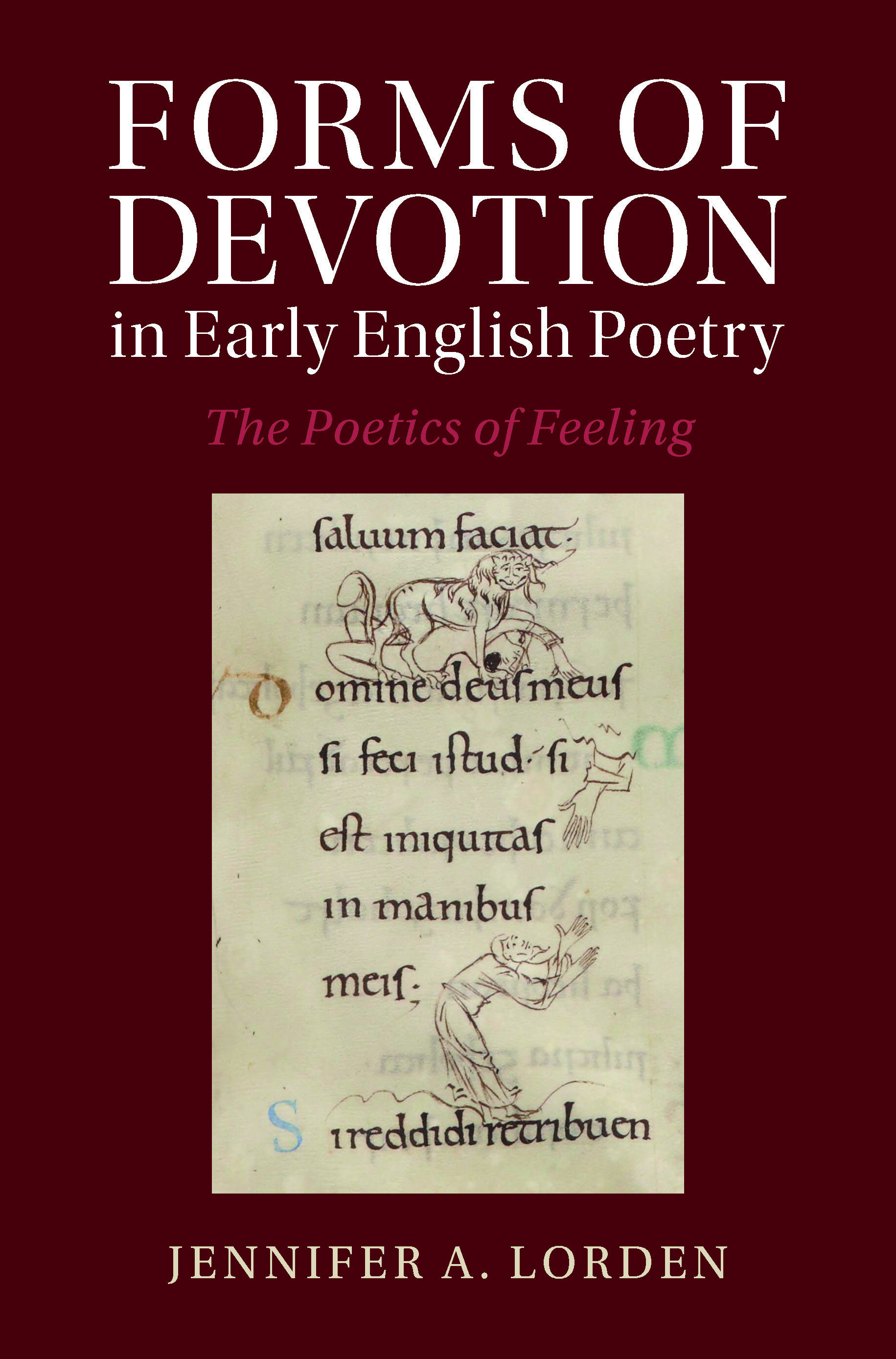
Jennifer Lorden reveals the importance of deeply-felt religious devotion centuries before it is commonly said to arise. Her ground-breaking study establishes the hybrid poetics that embodied its form for medieval readers, while obscuring it from modern scholars. Working across the divide between Old and Middle English, she shows how conventions of earlier English poetry recombine with new literary conventions after the Norman Conquest. These new conventions—for example, love lyric repurposed as devotional song—created hybrid aesthetics more familiar to modern scholars. She argues that this aesthetic, as much as changing devotional practice, rendered later affective piety recognizable in a way that earlier affective devotional conventions were not. Forms of Devotion reconsiders the roots and branches of poetic topoi, revising commonplaces of literary and religious history.
“…a welcome contribution to scholarship on the history of emotions and affect, medieval spirituality, and Old and Middle English poetry.” –Alice Jorgensen, Journal of English and Germanic Philology
“… her argument is compelling and reminds us, once again, how dangerous it is to draw our boundaries too firmly.” –Barbara Newman, Modern Philology
Literary Form in Early Medieval England. Cambridge Elements in England in the Early Medieval World. Cambridge University Press, 2025.
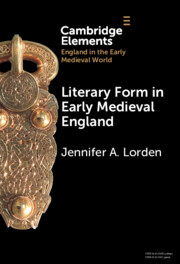
The earliest English writers left little comment on their literary forms. In contrast to the grammatical treatises of late antiquity or critical studies of contemporary and modern literature, early medieval English writing offers only sparse contemporaneous self-commentary, often in brief or conventional notes along the way to other things. But Old English and Latin literature had lively and evolving practices of literary form and formal innovation. Literary Form in Early Medieval England examines both more and lesser known forms, considering the multilingual landscape of early medieval England and showing that Old English literary forms do not simply end with the rupture of the Norman Conquest but continue in surprising ways. Literary Form in Early Medieval England offers a concise tour of what we do know of literary forms, both those that have received more attention and those that have been relatively overlooked, across the first six centuries of English literature.
Articles & Essays
“Just as We Read Anywhere: Type Texts, Intertexts, and the Earliest English Lives of Malchus.”
Modern Philology 123, no. 4 (2026), forthcoming.
The life of Malchus survives in three instances in early medieval England: in Aldhelm, in Ælfric, and in an anonymous prose life. In each of these instances, the story appears immediately adjacent to other narratives of chastity and sexual purity. But while these other chastity narratives focus on overcoming desire, Malchus’s story offers a counterpoint to these as a story of a lack of desire, and a model for chaste companionship. Considering each extant instance of the story of Malchus, I argue that his story appears consistently in pre-Conquest writing in England as an intertext, and an intertext offering a crucial contrast to stories of overcoming lust. Appearing so consistently in particular contexts, it offers something of a type text, able to evoke connotations of chaste companionship allusively. Rather than mere absence of lust, Malchus’s story offers the presence of chaste companionship, as both a lesson in itself and one teaching its audience to read exempla by means of other exempla.
“The Hero of his Own Life: Beowulf, Jesus, and the Poetics of the Old English Andreas.” Journal of English and Germanic Philology 123, no. 4 (2024), 443-66.
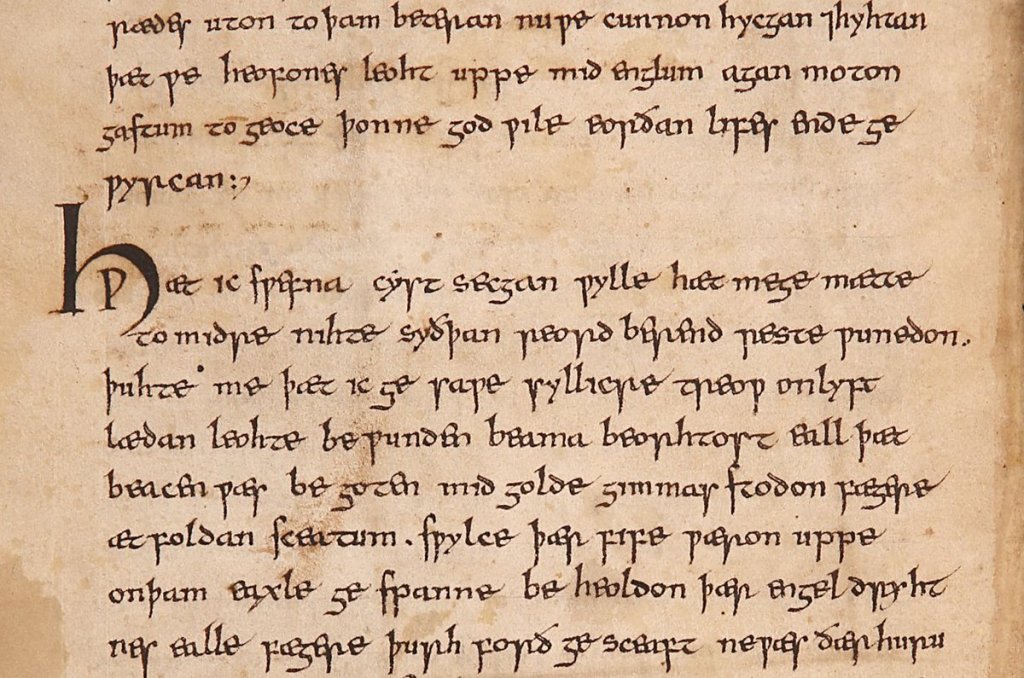
Uniquely among the Old English poetic saints’ lives, Andreas not only allows its saint to suffer, but extends his suffering as he, uncharacteristically for an Old English saint, begs God for it to stop. This is because, as I argue, Andreas is alone among the protagonists of Old English poetic saints’ lives in that he is not the figure whose suffering is displaced onto another character, who imperfectly but sympathetically dramatizes the magnitude of holy suffering. Instead, Christ, the sly sailor he fails to recognize, is that figure, and gets Andreas to recite the story for us. Understood in this way, the striking failings of Andreas as a saint are in fact inextricably linked to the aggressive intertextuality that has, at times, been seen as a failing of Andreas as a poem. In contrast to the heroes, both sacred and not, of other Old English poems using similar heroic tropes, Andreas appears all too imitable in his suffering and shortcomings. In this, Andreas both subtly and starkly reframes Christ as the real hero of the story, and of the other Old English heroic poetic saints’ lives, too. To make this point, Andreas builds a web of intertextual connections with other Old English texts—not just Beowulf, but poetic saints’ lives as well—to offer a subtle reframing of how holy and heroic protagonists ought to be regarded by an audience familiar with both.
“Feeling Thinking in the Old English Boethius.” New Medieval Literatures 24 (2024), 1-31.
In Book III of Boethius’ Latin Consolatio philosophiae (Consolation of Philosophy), Philosophia tells Boethius that her remaining teaching will cause pain when first tasted, yet grow sweet when ingested. When the Old English Boethius translates this section, however, Wisdom (Philosophia’s vernacular counterpart) adds the further specification that this medicine will be ‘swiðe swete to belcettan’—very sweet to belch. The metaphor of digestion extends a consideration of affective apprehension and contemplation that the text develops at some length. The digestive metaphor anticipates later figures of belching that will appear in, for example, Bernard of Clairvaux. But in context, the Old English elaboration upon the image suggests that both the sweetness, and certain kinds of similitude, must persist, as the Latin text increasingly leaves both of these things behind in favor of increasingly abstract philosophy. In this article I seek to demonstrate that the Old English translation of Boethius’ Consolatio philosophiae negotiates two historically specific phenomena as it adapts and extends the material of its source text: first, early English understandings of the embodied mind, and second, the role of embodied affect in devotion.
“The Desiring Mind: Embodying Affect in the Old English Pastoral Care.” Textual Identities in Early Medieval England: Essays in Honour of Katherine O’Brien O’Keeffe, ed. Jacqueline A. Fay, Rebecca Stephenson, and Renée R. Trilling (Boydell & Brewer, 2022), 54-69.
Through shifting and expanding explanations of the correct way to admonish others and how to manage one’s own relationship to authority, the Old English Pastoral Care consistently leaves room for emotional states in a way not found in the Latin original. Where, for example, the Latin straightforwardly condemns pride, the Old English explains how joy [gefea] for good works must be tempered with grief [unrotnes] for evil ones.10 Moreover, in lieu of Gregory’s diametrically-opposed dichotomies – the rich and the poor, the joyful and the sad, the prosperous and the afflicted – in which all need admonition one way or another, modifiers added to the translation open a slender middle ground between Gregory’s extremes and admonish only excessive states. This additional space, left for positive affect in particular, allows new avenues for feeling to define the moral character of action and ways of being. These subtle shifts in emphasis delicately decline to criticize all alike, as Gregory had, revealing the practical concerns of their early English translator. As we shall see, this opening of possibility for sanctioned, positive emotion also reflects the importance of feeling to religious devotion more generally, both in the text’s rhetorical positioning and in the broader religious context in which the translation was produced.
“Tale and Parable: Theorizing Fictions in the Old English Boethius.” PMLA 136.3 (2021): 340-55.
Scholarship has often considered the concept of fiction a modern phenomenon. But the Old English Boethius teaches us that medieval people could certainly tell that a fictional story was a lie, although it was hard for them to explain why it was all right that it was a lie—this is the problem the Old English Boethius addresses for the first time in the history of the English language. In translating Boethius’s sixth-century Consolation of Philosophy, the ninth-century Old English Boethius offers explanatory comments on its source’s narrative exempla drawn from classical myth. While some of these comments explain stories unfamiliar to early medieval English audiences, others consider how such “false stories” may be read and experienced by those properly prepared to encounter them. In so doing, the Old English Boethius must adopt and adapt a terminology for fiction that is unique in the extant corpus of Old English writing.
“Revisiting the Legendary History of Deor.” Medium Ævum 90.2 (2021): 197-216.
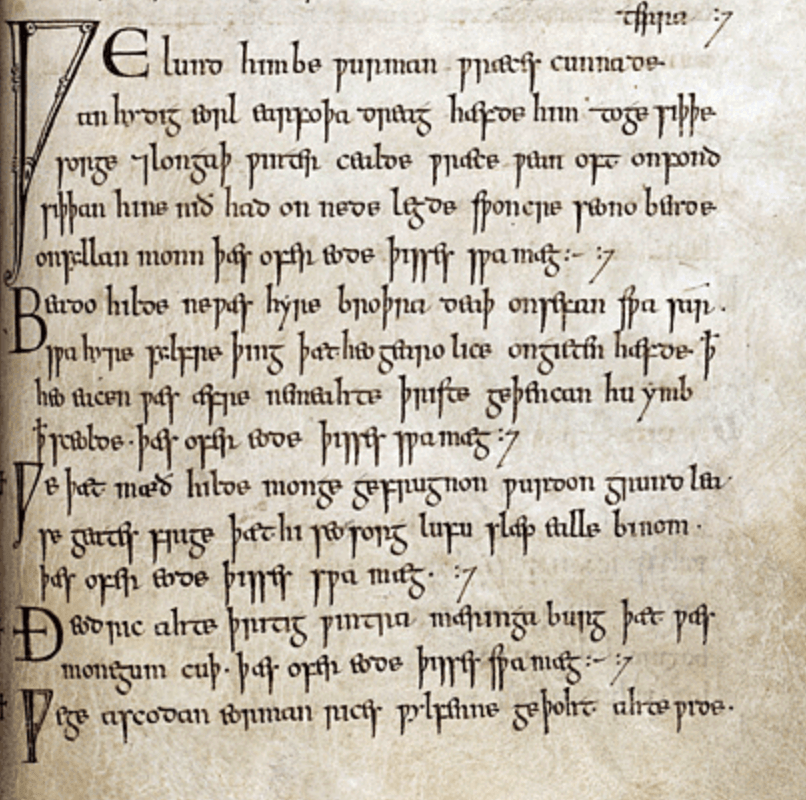
The Deor we know from scholarship is a poem comprising episodes, isolated ‘examples’ illustrating the ‘moral … that when adversity comes we are to endure it, taking what small comfort we can from the thought that it will eventually pass’. This article, however, argues that a relative wealth of Germanic analogues allows us to see the legendary episodes not as various stories partly obscured by time, but as points in a well-known, sequential narrative history. When we set aside the doubtful emendations of the third section and read Deor against its closest extant analogues the allusive sections remaining suddenly tell a linear narrative of the legends surrounding Weland, his son Widia, and the kings they directly serve, who make and break their fortunes by turn. This legend lies behind not only the first two sections, nor even the first three, but behind all five of the legendary episodes preceding the narrator’s turn to his own tale of misfortune. In this light, not only the plot but the significance of the poem changes. Even when its turns of fortune appear unpredictable, there is a causal relationship between the turn of fortune in each episode and the circumstances of the next. With this in mind, the moral of the poem is not one of arbitrary, fickle fortune, illustrated through exempla drawn from a collection of stories, but a sustained argument in which each turn deserves another across an extended, linear, family legend.
“He eft astod: A Verbal Motif in Beowulf.” Notes and Queries 67.3 (2020): 351-354.
Not all of the emotional weight of Old English poetry is given explicit verbal expression. As the poet of Maxims I declares, ‘Hyge sceal gehealden, hond gewealden’ [The spirit should be held, the hand wielded] (l. 121). Along these lines, when Hrothgar mourns the loss of his closest confidant, Beowulf responds, ‘Ne sorga, snotor guma; selre bið æghwæm / þæt he his freond wrece, þonne he fela murne’ [Do not grieve, wise man; every man is better that avenges his friends, than one that deeply mourns] (Beowulf, ll. 1384–5). In place of verbal expression, Beowulf itself uses conventional, concrete description to both reveal psychological states and foreshadow further action, both of which its heroes must carefully control. One such significant overlooked description is Beowulf’s sitting or standing at crucial moments, particularly through the construction [adverb] + astod. In the three instances of this verbal motif in the poem, the poet reverses a poetic type scene in which a figure sits while mourning by emphasizing key triumphant moments at which Beowulf stands instead and turns the tide of battle.
“Discernment and Dissent in the Cynewulf Poems.” Modern Philology 116.4 (2019): 299-321.
The anomaly of the signed Old English “Cynewulf” poems is essentially a textual one: all of the signed poems evince mastery of both Old English and Latin poetic conventions from ornamental rhyme to the innovative acrostic that makes the unique runic signatures possible. But those runic signatures make something else possible: the only intertextual poetic project in Old English, identifiable across texts, across manuscripts, and perhaps across individual authors. As I argue, “Cynewulf” is, above all, a literary device, an inscribed, erudite persona whose presence marks a rarefied intertextual project. The poems’ influences and interests make it “overwhelmingly likely” that they originate among those who were “educated within the church and maintained some official affiliation to it.” The concern with not only teaching but higher-order discernment appears most appropriate to a bishop or a bishop’s immediate circle, or to the higher levels of a monastic institutions in which learning and discernment were issues of particular responsibility. Furthermore, the presence of Cynewulf poems in half of the four major poetic codices renders legible the intertextual relationships between poems comprising this poetic project, while their apparent influence on other extant poems demonstrates the importance of the Cynewulfian body of texts as a remarkable phenomenon within the history of Old English literature. The authority conveyed by “Cynewulf” as a figure within these poems may or may not be that of an “author,” but is certainly constructed as that of a recognizable and, more important, a recognizably ecclesiastical, authority.
“Landscapes of Devotion: The Settings of St Swithun’s Early uitae.” Anglo-Saxon England 45 (2016): 285-309.
Although post-Conquest uitae of St Swithun narrate the saint’s earthly life, the original tenthcentury accounts relate only his post-mortem miracles, professing ignorance of his life as Bishop of Winchester. Most of the miracles in these pre-Conquest uitae take place in or in some way revolve around the site of the saint’s relics at the Old Minster, Winchester. Late-tenth-century Winchester, along with the Benedictine Reformers who had taken up residence there, thus figures prominently in these miracle stories; indeed, Winchester comes to be the true protagonist of Swithun’s pre-Conquest uitae. Moreover, each of Swithun’s three pre-Conquest hagiographers – Lantfred, Wulfstan the Precentor, and Ælfric – writes a different Winchester according to his relationship to that place. This phenomenon illuminates these writers’ differing relationships to the Benedictine Reform, as well as how the Reformers sought to write their own histories.
“Rewriting Beowulf: Old English Poetry in Contemporary Translation.” Quaestio Insularis 10 (2011 for 2009): 60-74.
An article considering contemporary translations of Beowulf and the implicit and explicit assumptions about the functions and intended audiences of translation.
Encyclopedia Entries
“Deor.” The Wiley-Blackwell Encyclopedia of Medieval Literature in Britain, ed. Siân Echard and Robert Rouse (Oxford: Wiley-Blackwell, 2017), pp. 657-658.
Book Reviews
Review of Alice Jorgensen, Emotional Practice in Old English Literature. The Medieval Review, 25.05.08 (2025).
Review of Nicholas Watson, Balaam’s Ass: Vernacular Theology Before the English Reformation, Volume I: Frameworks, Arguments, English to 1250. Modern Philology 120, no. 4 (2022).
Review of Maren Clegg Hyer and Gale R. Owen-Crocker, eds., Sense and Feeling in Daily Living in the Early Medieval English World. Journal of British Studies 61, no. 3 (2022): 738-739.
Review of Myra Uhlfelder, The Consolation of Philosophy as Cosmic Image. The Medieval Review, 21.02.07 (2021).
Review of Language and Culture in Medieval Britain: The French of England c. 1100-c. 1500; ed. Jocelyn Wogan-Browne, et al. Academia (2010).
Invited Lectures
2025 “Bathhouses, Battle Scars, and Unicorns: Fiction and Belief in Early England.” Invited Lecture, Department of English and MEMS, 11 November, Wake Forest University, Winston-Salem, North Carolina.
2025 “Nonimpossible Things: St. Eustace’s Crisis of Belief.” Invited Colloquium Presentation, Yale Medieval Colloquium, 7 February, Yale University, New Haven, Connecticut.
2024 “Mixed Feelings: Finding Medieval Affect in Early English Poetics.” Keynote Address, Cornell Medieval Studies Student Colloquium: “Medieval Subjectivities,” 2 March, hosted virtually by Cornell University, Ithaca, New York.
2024 “The Miraculous and the Merely Unlikely: Belief in the Lives of St. Eustace.” Invited Symposium Presentation: “Fictions, Elsewheres, and Otherworlds: New Work in Early English Studies,” 15 February, University of North Carolina, Chapel Hill.
2019 “Old and Untrue: The Fictionality of the Old English Boethius.” Invited Lecture, 10 October, University of North Carolina, Chapel Hill.
2019 “‘Rude Exclamations’: Beowulf, Identity, and the Making of Medieval English.” Invited Lecture, 21 March, Bates College, Lewiston, Maine.
Selected Recent Conference Presentations
2025 “The Shifting Saints of Early Medieval England.” Panel: “Multilingualism in Pre-Norman Britain.” International Congress on Medieval Studies, 10 May, Western Michigan University, Kalamazoo, Michigan.
2024 Invited Roundtable: “Looking Forward.” Invited Participant, Emotions and Multilingualism Workshop, 26 July, presenting virtually, Trinity College Dublin, Ireland.
2024 “As if it were a Dove: Frame Narrative and the Old English Life of Malchus.” Panel: “Story Worlds in Old English and Anglo-Latin Literature.” International Medieval Congress, 1-4 July, University of Leeds, United Kingdom.
2024 “Transformation: Saving St Eustace in Old and Middle English.” Panel: “Being Moved.” Medieval Academy of America Annual Meeting, 14-16 March, University of Notre Dame, South Bend, Indiana.
2023 “Educating Apollonius: The Role of Historia in Old English Prose.” Panel: “Thinking about History through Old English Literature.” International Medieval Congress, 3 July, University of Leeds, United Kingdom.
2022 “Bodies that Shatter: Poetics and the Place of Suffering in the Old English Andreas.” Southeastern Medieval Association (SEMA) Conference, 10-12 November, Birmingham, Alabama.
2021 “Blended Voices: The Ambiguous Lament of Advent Lyric VII.” Panel: “Literary Relationships: Devotion, Anachronism, and Objectification in Old and Middle English Texts.” Medieval Academy of America Annual Meeting, 15 April, hosted virtually by the University of Indiana, Bloomington.
2020 “Sympathy for the Virgin in the Old English Advent Lyrics.” Medieval Academy of America Annual Meeting, 26 March, University of California, Berkeley. *Cancelled due to COVID-19.
2019 “The Poetics of the Speaking Soul in Early Middle English.” Panel: “Conceptions of Death and Dying in Early Medieval Literature,” sponsored by the Early Middle English Society. International Conference on Medieval Studies, 11 May, Western Michigan University, Kalamazoo, Michigan.
 Jennifer A. Lorden