New Book – Literary Form in Early Medieval England – Available Open Access for a Limited Time!

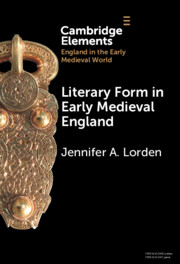
My newest book, Literary Form in Early Medieval England, is available open access here for the next two weeks! Come download it for free! This is part of the Cambridge series Elements in England in the Early Medieval World.

Here’s a quick description of the book:

“The earliest English writers left little comment on their literary forms. In contrast to the grammatical treatises of late antiquity or critical studies of contemporary and modern literature, early medieval English writing offers only sparse contemporaneous self-commentary, often in brief or conventional notes along the way to other things. But Old English and Latin literature had lively and evolving practices of literary form and formal innovation. Literary Form in Early Medieval England examines both more and lesser known forms, considering the multilingual landscape of early medieval England and showing that Old English literary forms do not simply end with the rupture of the Norman Conquest but continue in surprising ways. Literary Form in Early Medieval England offers a concise tour of what we do know of literary forms, both those that have received more attention and those that have been relatively overlooked, across the first six centuries of English literature.”

CFPs for Old English Panels at MLA 2026 in Toronto!

The Old English Forum will be sponsoring the following two panels at the MLA Convention in Toronto meeting from January 8-11, 2026. We’re accepting 250-word proposals until March 15, 2025 for 15-20 minute papers. Please share widely!! And don’t hesitate to get in touch with any questions.


Language Play in Old English Literature

This session invites papers on how Old English texts play with language, from riddles to word play, from uses of humor to scenes of play, broadly defined. Papers might consider multilingual language effects, reversals of conventional formulas, uses of runes or ciphers, and other linguistic special effects across genres and formal conventions, across translations and adaptations, and across the boundaries of language. Send a 250-word proposal and CV to jalorden@wm.edu and saltzman@chicago.edu by 15 March, 2025. 

Please note that all accepted presenters must be members of MLA by 7 April, 2025.


Devotional Forms in Old English Literature

This session invites papers on how Old English texts explore questions of religious and spiritual devotion, broadly conceived. Papers might focus on monastic life, poetry, hagiography, homiletics, and other genres, forms, and spaces for devotional expression in early medieval England. Send a 250-word proposal and CV to jalorden@wm.edu and saltzman@chicago.edu by 15 March, 2025. 

Please note that all accepted presenters must be members of MLA by 7 April, 2025.

CFPs for Old English Panels at MLA 2025

CFPs for Old English Panels at MLA 2025 in New Orleans – please share widely! Abstracts due by March 15.

INVISIBLE VIOLENCE AND ARCHIVAL ERASURE

Recent scholarship on early medieval England has provoked a reparative moment: as researchers, often early career scholars, engage newly explicitly diverse theoretical and political commitments, they ask us all to re-evaluate the ways that we determine our field and navigate the archives that constitute it. This session aims to foreground such important work and to consider not only ways that past scholarship and the medieval archive itself might perpetuate racist, antisemitic, Islamophobic, homophobic, transphobic, ablest, misogynist paradigms of thought and being, but also how a focus on this aspect of medieval and medievalist archives might enable some disentanglement of the violences, omissions, and silences of the archive from the perpetuation or creation of those violences in the scholarship.

Papers might include those that theorize Old English poetry and prose; study the history of scholarship that has perpetuated the abuses and omissions of the past; articulate methodologies that might uncover the lives of medieval people previously excised from scholarly histories; etc. Send a 250 word abstract and CV to Jennifer Lorden (jalorden@wm.edu) and Benjamin Saltzman (saltzman@uchicago.edu).

THE POETICS AND POLITICS OF VISIBILITY IN OLD ENGLISH

Much scholarship has considered how Old English literature handles sensory information, and in particular models of seeing or being seen, and how certain images and scenes evoke associations that resonate across the poetic corpus. At times, Old English poetry also temporarily withholds images from view, only for them to be revealed later with heightened effect. For its part, scholarship in the field has also focused attention on particular images of Old English poetry, leaving other aspects of the literature overlooked or even concealed.

This session invites papers considering how Old English poetry and the modern study thereof have made things visible or withheld them from view, or used figurative and literal depictions of vision. Approaches might range from studies of poetics to affect studies, disability studies to gender and sexuality, and/or considerations of the ways Old English texts handle the figurative and literal implications of sensory perception. Send a 250 word abstract and CV to Jennifer Lorden (jalorden@wm.edu) and Benjamin Saltzman (saltzman@uchicago.edu).

EXPERIMENTS IN NEW POETRY WITH OLD ENGLISH, OLD FRENCH, AND OLD SPANISH: A ROUNDTABLE

We invite poets who have engaged with or are interested in engaging with Old English, Old French, and/or Old Spanish to participate in a roundtable as an occasion to reflect on, speak to, or experiment with modes of translation, inspiration, revision, and other ways of creating in relation to the earliest forms of these languages. This special session is organized by members of the Poetry and Poetics Forum, the Old English Forum, the Medieval Iberian Forum, and the Medieval French Forum. Send 250 word abstract and CV to Benjamin Saltzman at saltzman@uchicago.edu.